
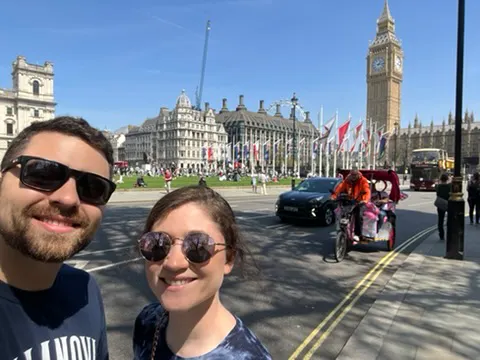
Between 2024-2025, I had the amazing opportunity to live and work in the UK as a Physical Therapist. Not only did I travel to 17 different countries and immerse myself in countless different cultures; but, I got to experience first hand the differences between the US and UK health care systems and what it was like to be a physical therapist overseas.
Some differences were small, mostly changes in terminology; while other differences were a bit more noticeable, such as the way that each health care system operates.
Let’s break it down so you can understand the major differences!
- In the UK, we aren’t called Physical Therapists or PTs… we’re called physiotherapists! In fact, in the UK if you use the terminology PT, people will assume you are talking about a personal trainer.
- Education and Training
- In the USA, all new graduate PTs are required to complete a 3 year doctorate degree after their undergraduate. Then, they are required to pass the National Physical Therapy Exam (NPTE) and complete continuing education based on their state’s requirements in order to maintain licensure.
- In the UK, a 3-4 year Bachelors in Physiotherapy is required. If a person already has a degree in a related field, they can do a 2 year conversion degree too. Then, all physios must be licensed with the Health and Care Professions Council (HCPC).
- Access to care:
- In the US, many states allow direct access. This means that you can make an appointment with a Physical Therapist without a doctor’s prescription for a certain amount of time/certain number of visits. Because of this, it is a lot easier to get seen right away.
- In the UK, you always need a GP referral in order to be able to receive treatment. And a lot of times, if you are going through National Health Service (NHS) as opposed to private insurance, it could take 6-8 weeks for you to even see your physiotherapist.
- Cost Comparison
- In the US, the cost of physical therapy can greatly vary depending on insurance coverage. Typically an out-of-pocket session can run you between $100-250.
- In the UK, all have access to the NHS. Because the UK takes a socialized medicine approach, everyone has access regardless of socioeconomic status. In addition, there are also private insurance companies that people usually receive services from through their employer. An out-of-pocket session in the UK will usually run you between £40-80 – that’s about $55-110!
- Treatment Style
- In the US, because of insurance coverage, patients are often seen multiple times a week which allows for a more hands on approach from the therapist. You also might see more use of modalities in the US like e-stim and dry needling.
- Due to the infrequency of visits given by the NHS and the decreased number of sessions provided by private insurance, a lot of the focus of physio sessions is on a really good home-exercise program for self-management.
As you can see, there are some pretty significant differences between PT in the US vs. the UK in regards to education, cost, and access to care; but, ultimately the goal for a PT/physiotherapist is always the same: to help restore our patient’s function and accomplish their goals!
Schedule today to meet Maddy 484-841-6154
Sources